1. The Foshan Cluster Advantage: Industrial Metallurgy & Cabinet Profile Architecture
In contemporary interior architecture and hospitality procurement, kitchen cupboard doors have transitioned from passive joinery components to active engineering elements. Standard wood-derived substrates—such as Medium Density Fiberboard (MDF), particleboard, and even marine plywood—suffer unavoidable structural failures when deployed in environments with frequent thermal cycling and relative humidity exceeding 65%. Typical failure modes include delamination, edge-banding separation, hygroscopic swelling, and formaldehyde outgassing under heat.
As the leading cluster in China's industrial heartland, Foshan extrudes over 40% of the world's high-precision architectural aluminum. By leveraging primary virgin electrolytic aluminum ingots (Grade A00) rather than mixed post-consumer scrap, our extrusions achieve the rigorous chemical equilibrium dictated by EN 755-9 and ASTM B221 standards. The primary structural profile for premium aluminum kitchen cupboard doors is 6063-T5 alloy, exhibiting an ultimate tensile strength ≥ 160 MPa, yield strength ≥ 110 MPa, and elongation ≥ 8%. This alloy provides exceptional dimensional stability across 2.8-meter full-height pantry and cupboard frontages with zero bowing.
"Specifying 6063-T5 aluminum kitchen cupboard doors guarantees a hygroscopic expansion coefficient of zero, fully mitigating the edge swelling, mold infestation, and hinge-sag failure common to wood-core alternatives in tropical and coastal climates."
Alloy Metallurgy: 6063-T5
Carefully controlled magnesium (0.45-0.9%) and silicon (0.2-0.6%) composition creates optimal Mg2Si precipitate phases, delivering superior surface smoothness necessary for aerospace-grade anodizing and PVDF coating.
Surface Passivation
Anodized coatings (class AA15 or AA20 per ISO 7599) yield minimum 15–20 μm oxide layers, passing 3,000-hour neutral salt spray (ASTM B117) tests with zero pitting, bubbling, or discoloration.
Hermetic Edge Engineering
Internal Santoprene co-extruded EPDM gaskets cushion tempered safety glass inserts against thermal expansion stresses while sealing out airborne culinary fats, steam, and cleaning fluids.
2. Structural Performance Comparison: Aluminium vs Traditional Cabinet Fronts
For institutional specifiers, procurement heads, and real estate developers, selecting materials involves evaluating total lifecycle costing, installation cycle times, fire safety codes, and maintenance footprints. Below is an exhaustive technical benchmark comparison between Foshan-manufactured aluminum cupboard systems and legacy substrates.
| Performance Parameter | Foshan 6063-T5 Aluminium Glazed Doors | MDF / HDF UV Lacquered Fronts | Solid Hardwood (Oak / Walnut) |
|---|---|---|---|
| Moisture Absorption Rate | 0.0% (Totally Impervious) | 8.0% - 15.0% (Risk of Swelling) | 5.0% - 12.0% (Subject to Warping) |
| Dimensional Stability (2800mm Span) | ≤ 0.5 mm Deflection over 10 Years | 3.0 - 8.0 mm (Hinge Drift Common) | 4.0 - 12.0 mm (Seasonal Expansion) |
| Fire Classification (EN 13501-1) | Class A1 / A2-s1, d0 (Non-Combustible) | Class D-s2, d0 (Combustible) | Class D-s2, d0 (Combustible) |
| Formaldehyde Emission Rating | ENF Grade (Zero Emissions, 0.00 mg/m³) | E1 to E0 (Resin Binder Dependent) | Natural Base (Adhesive Dependent) |
| Hardware Fastener Retention | Internal Extruded Screw Channelling | Direct Core Screw (Degrades over time) | Direct Pilot Wood Threading |
| Service Life Cycle Expectancy | 25 - 30+ Years with Zero Degradation | 5 - 8 Years in High Humidity | 12 - 18 Years (Requires Refinishing) |
3. Modern Product Selection & Architectural Application Classifications
As kitchen layouts evolve toward unified living-dining open concepts, aluminum cupboard doors perform diverse zoning and aesthetic functions. Our export engineering team supplies three primary product families to global hospitality and multi-unit residential projects:
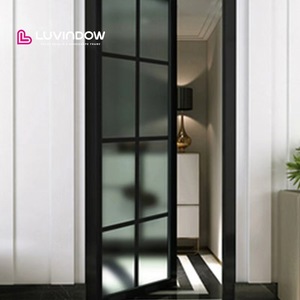
Ultra-Slim Fluted & Smoked Glazed Doors
Utilizing micro-sightline 18mm or 20mm anodized perimeter extrusions, these doors hold 4mm or 5mm low-iron tempered reeded (Moru), fluted, or bronze/grey smoked glass. Engineered for high-end illuminated wine cellars, display larders, and luxury upper kitchen cabinets.
Integrated J-Pull & Handleless Profiles
Extruded with ergonomic integrated finger grooves (Gola/J-Pull/L-Pull) continuous along the vertical or horizontal edge. This eliminates the need for drilled handles, preventing mechanical handle loosening and maintaining clean minimalist aesthetics.
Ceramic Slate & Sintered Stone Inlays
High-tensile structural honeycomb aluminum backer panels surfaced with 3mm Italian-style porcelain sintered stone or metallic honeycomb panels. Delivers a scratch-proof, heat-proof, and chemical-impervious facade for heavy-duty lower prep cabinets.
4. Future Global Procurement Trends (2025–2030)
Data from global development tenders and international design exhibitions reveals four decisive market shifts dominating aluminum cabinet door manufacturing:
A. Low-Carbon "Green Aluminium" & Circular Certification: Global contractors are requiring Environmental Product Declarations (EPDs) and Low Carbon certification (≤ 4.0 kg CO2 per kg of primary aluminum). DERCHI utilizes renewable hydro-powered smelting allocations to drastically decrease embodied emissions.
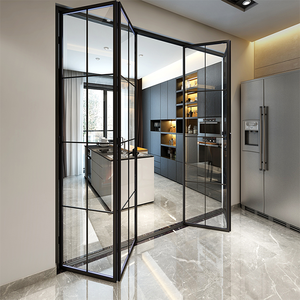
B. Flush Coplanar & Pocket Sliding Systems: Space optimization in metropolitan high-rises (Singapore, London, New York) has accelerated demand for 2-leaf and 3-leaf coplanar sliding cupboard systems. Profiles require micro-tolerances (±0.2mm) to glide seamlessly and park flush with adjacent walls.
C. Integrated Low-Voltage Architectural Illumination: High-end cabinet extrusions now integrate concealed internal wiring channels and diffusers for 12V/24V LED strip lighting directly into the door stiles. This creates ambient interior cabinet lighting without visible wires.
D. Soft-Closing Pocket Pivot Hardware Adaptations: Commercial architects increasingly specify concealed pivot hinges (such as Salice Air, Blum Cristallo, or Grass Tiomos) recessed directly into the aluminum frame without routing through glass panels.