Engineered Fenestration Systems & Recommended Casement Solutions
Precision-tested thermal-break frames, hurricane impact ratings, and multi-point sealing profiles custom-extruded for demanding worldwide building standards.
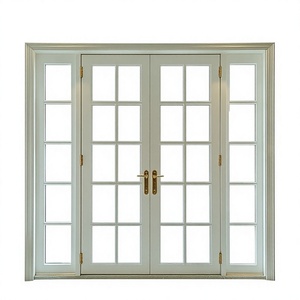
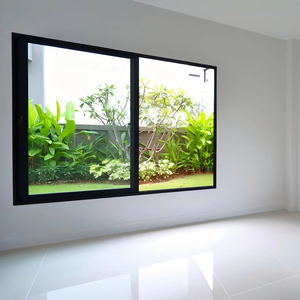
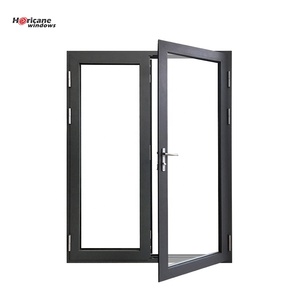
The Global Procurement Shift: Why Top Exporters Dominate China's Casement Window Supply Chain
In-depth architectural analysis into structural engineering, extrusion alloys, automated thermal breaks, and quality control systems in Foshan's manufacturing corridor.
Global commercial developers, institutional general contractors, and residential building suppliers increasingly look to tier-one Chinese aluminum fenestration exporters to reconcile rigorous international building codes with scalable factory economics. The modernization of China's aluminum industrial base—anchored primarily in the Nanhai District of Foshan, Guangdong—has transformed the global casement window market. Once categorized as low-cost volume fabrication, leading manufacturers now engineer bespoke fenestration suites rivaling German and Swiss envelope systems in acoustic attenuation, airtightness, and structural deflection thresholds.
Aluminum casement windows remain the primary system of choice for mid-rise to luxury high-rise developments due to their mechanical compression sealing. Unlike sliding window systems that rely on brush seals prone to friction wear and moisture ingress over operational cycles, casement designs leverage continuous EPDM multi-cavity gaskets pressed tightly against the frame profile via multi-point perimeter gear hardware. When evaluating premier exporters, professional specifiers must dissect five key technical parameters: primary billet purity (6063-T5 vs. 6063-T6 virgin aluminum versus recycled scrap), thermal break structural configuration (polyamide PA66 GF25 insulative strips versus inferior PVC infills), precision corner jointing technology, glass assembly gas-retention, and anti-corrosion surface coating guarantees.
Alloy Metallurgy & Extrusions
Premier exporters use certified primary 6063-T6 or 6060 architectural aluminum billets. Nominal wall thicknesses adhere to strict commercial thresholds (≥1.8mm for high-wind residential; ≥2.2mm-3.0mm for high-altitude commercial envelopes), providing maximum wind load resistance (up to 5000 Pa design pressure) and deflection tolerance (L/175 or L/250).
Polyamide Thermal Barriers
Eliminating bridging issues in extreme temperature deltas requires multi-cavity Technoform PA66 GF25 (25% glass fiber reinforced polyamide) barriers. High-end casement systems feature barrier widths from 24mm up to 39mm, achieving whole-window U-values down to 0.8 – 1.4 W/m²·K for Passive House, NFRC, and CE compliance.
Pin-Injected Corner Cleating
Industrial structural integrity relies on machine-crimped corner brackets coupled with two-component polyurethane (PUR) corner joint glue injection. This automated injection technique ensures zero structural frame racking during shipment, eliminates corner weld fatigue, and prevents water infiltration at profile miter joints.
Engineering Matrix: Chinese Export Tiers vs. Global Standards
A side-by-side performance benchmark comparing premium Foshan export standards against common US, Australian, and European fenestration mandates.
| Technical Metric | Tier-1 China Exporters (DERCHI Standard) | North American (NFRC/AAMA) | Oceania (AS2047 / AS1288) | European Union (EN 14351-1) |
|---|---|---|---|---|
| Aluminum Alloy & Temper | ✓ 6063-T5 / T6 High-Tensile Virgin | AAMA 101 Standard Spec | AS/NZS 1866 Certified | EN AW-6063 / EN 755-9 |
| Air Infiltration Rate | ≤ 0.05 m³/(m·h) (Class 8 / 600 Pa) | ≤ 0.30 cfm/ft² @ 75 Pa | Level 300 / 450 Pa Low Infiltration | Class 4 (≤ 3 m³/(h·m²) @ 600 Pa) |
| Water Penetration Resistance | ≥ 700 Pa – 1050 Pa (Static & Cyclic) | 15% of positive design pressure (DP50+) | Pass 450 Pa – 600 Pa Cyclic Test | Class E900 to Class E1200 (>900 Pa) |
| Multi-Point Perimeter Locking | Exclusive 4-Side 6-Point Security Patented | Single/Double Cam Multi-Point | Hook Deadbolt & Multipoint Friction | WK2/RC2 Anti-Burglar Gear Locks |
| Thermal Insulation (U-Factor) | Uw 0.8 – 1.4 W/m²·K (Triple/Low-E) | U-Factor 0.20 – 0.28 Btu/h·ft²·°F | U-value ≤ 2.2 W/m²·K Required | Uw ≤ 1.1 W/m²·K (Passivhaus ≤0.8) |
| Acoustic Attenuation (STC / Rw) | Rw 38 dB – 46 dB (Acoustic PVB Laminated) | STC 36 – 44 High Noise Rating | Rw+Ctr > 32 – 38 dB | Sound Class 4 – 5 Sound Insulation |
Emerging Procurement & Future Development Trends (2025–2030)
How strict carbon accounting, smart building integration, and extreme weather resilience are reshaping the architectural window procurement lifecycle.
Ultra-Narrow Frame Panoramic Sightlines
Architects are abandoning bulky exterior frames. Next-generation casement windows feature flush sashes, concealed hinges, and ultra-slim interlocking stiles (down to 25mm visible sightline) without sacrificing wind deflection or water discharge efficiency through hidden stepped sill sub-drainage channels.
Mechatronic & Smart Façade Automation
The convergence of commercial HVAC networks and natural ventilation has accelerated demand for built-in 24V concealed chain actuators. Microprocessors embedded within the thermal break profile coordinate with building management systems (BMS) for motorized night purge cooling, rain sensor automated closure, and fire smoke evacuation.
Life-Cycle Carbon & Recycled Aluminum Billets
Under international green building standards (LEED, BREEAM, Green Star), structural procurement demands certified Environmental Product Declarations (EPDs). Leading Foshan factories are adopting low-carbon hydro-powered extruded billets (hydro-aluminum) with recycled scrap content surpassing 40%, cutting embodied emissions significantly.
Factory Authority: Guangdong Dejiyoupin Doors and Windows Co., Ltd. (DERCHI)
Over 25 years of engineering mastery, a 180,000 m² high-efficiency production cluster, and world-class testing infrastructure.
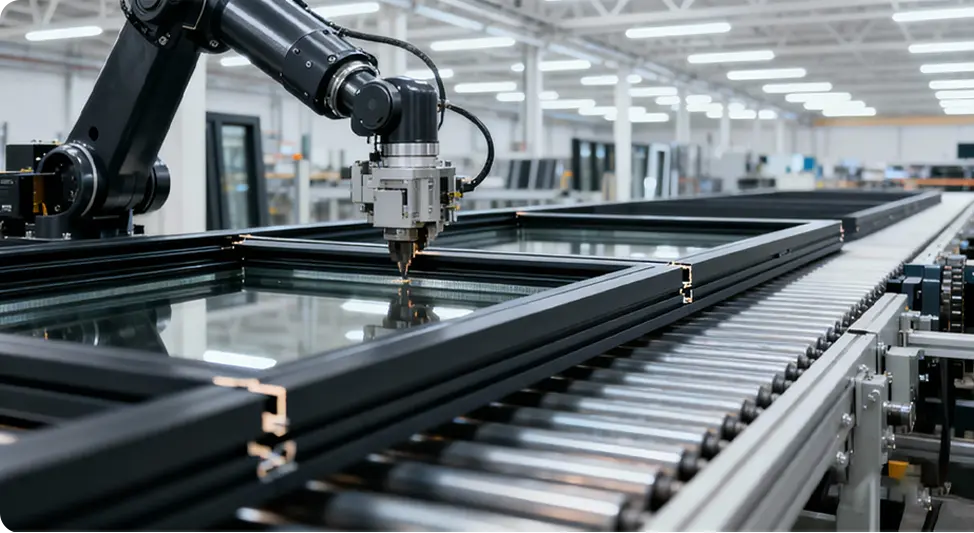
180,000 m² Production Ecosystem & 1M m² Annual Capacity
Our intelligent smart manufacturing base houses multi-axis CNC double-head cutting saws, automated 4-corner crimping centers, and robotic structural silicone sealing stations. This scale empowers phased floor-by-floor containerized delivery for multi-tower developments, resorts, and hotel chains without schedule delays.
100+ Patents & Patented Four-Side Six-Point Locking
Our dedicated R&D engineering wing (30+ senior façade engineers) created the industry-celebrated 4-side 6-point perimeter lock invention patent. This mechanism applies simultaneous uniform pressure around the sash perimeter, preventing prying attempts and ensuring total gasket compression against category 5 typhoon pressures.
360° Full-Cycle Quality Control (QC) & Global Accreditations
Every batch of aluminum casement windows undergoes rigorous 360-degree quality inspections prior to packing: profile gauge verification, corner shear strength, air tightness, water spray rack testing, and hardware cycle tests (200,000 opening cycles). Our products carry CE, NFRC, AS2047, CSA, Energy Star, and ISO 9001 certifications.
End-to-End Architectural Customization (8-Step Protocol)
From initial CAD/BIM drawing translation, climate-specific thermal calculations, and mock-up sample extrusion to job-site laser measurement validation and on-site engineering guidance, DERCHI minimizes overseas specification risks for architects and property developers across 300+ dealership networks worldwide.
Frequently Asked Questions (FAQ) for Global Fenestration Importers
Direct technical answers addressing structural wind load, corrosion resistance, customs compliance, glass selection, and factory validation.
Q1: How do Chinese aluminum casement windows hold up against extreme coastal typhoons and hurricanes?
Top-tier exporters engineer systems specifically for coastal storm belts (such as Florida, the Caribbean, the Philippines, and Japan). We specify 6063-T6 heavy-duty profiles with corner corner-cleat pin-injected PUR jointing, multi-point lock arrays along all four perimeter edges, and laminated impact glass units (e.g., 6mm Tempered + 1.52mm SentryGlas/PVB + 6mm Tempered). These systems withstand cyclic wind loads upwards of ±4500 Pa to 5000 Pa, fully complying with ASTM E1886/E1996 Large Missile Impact Level D standards.
Q2: What surface coating standard is required for oceanfront or high-salinity marine environments?
Standard architectural powder coatings degrade rapidly under constant salt spray. For installations within 5 kilometers of the shoreline, we mandate either 25-micron Fluoropolymer PVDF coating (complying with AAMA 2605 specifications with 70% Kynar 500 resin) or Qualanod-certified Class 1 anodic oxidation (20–25 μm film thickness). These surface treatments resist chalking, blistering, chipping, and color shift across 20- to 30-year lifecycle exposures.
Q3: What is the primary difference between outward-opening and inward-opening casement windows?
Outward-opening casements are popular in tropical and monsoon regions because external positive wind pressure pushes the sash tighter against the frame's perimeter EPDM gaskets, dramatically improving water and airtightness. Inward tilt-and-turn casements dominate Europe and colder climates, allowing secure tilt ventilation, effortless interior glass cleaning for multi-story towers, and high-performance multi-cavity perimeter compression.
Q4: How do you prevent condensation on aluminum frames in hot/humid or sub-zero climates?
Condensation occurs when moist interior air encounters a profile whose surface temperature is below the dew point. We prevent this by engineering true structural thermal breaks using Technoform PA66 GF25 polyamide insulation strips (≥24mm depth) that physically separate the interior and exterior aluminum profiles. Paired with warm-edge spacer warm-edge IGUs filled with 90%+ Argon gas, this limits thermal bridging and condensation.
Q5: What are standard factory lead times, packaging methods, and shipping damage mitigation protocols?
Standard custom fabrication requires 25 to 35 business days following final shop drawing and finish sample approval. Export packaging is engineered for ocean freight: profiles are covered with protective anti-scratch films, encased in custom high-density EPE foam buffers, sealed within vacuum plastic wraps, and crated inside fully-enclosed, fumigation-free ISPM-15 plywood cases with steel strapping and interior desiccants to prevent sea-air moisture damage.
Q6: How can international buyers verify quality control before shipment without traveling to China?
We provide full third-party and remote digital quality control verification. This includes providing complete batch metallurgical mill test certificates (MTC), dimensional laser scanning reports against signed shop drawings, continuous high-definition video inspections during corner jointing and hardware testing, calibrated water spray test videos, and facilitating third-party audits via inspection agencies such as SGS, TÜV, or Bureau Veritas prior to container loading.
Execute Your Next Fenestration Project with Engineering Certainty
Partner directly with Guangdong's premier aluminum window and door manufacturing facility. Send your architectural drawings, tender schedules, or custom structural specifications to our engineering team for a detailed technical cost breakdown within 24 hours.
Send an Inquiry