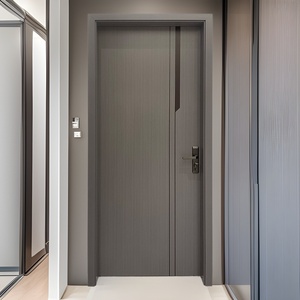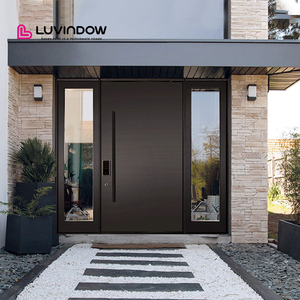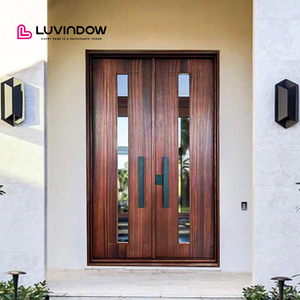
Luvindow Custom USA Villa Modern Exterior Solid Wood Entry Pivot Door
Solid composite hardwood core backed with heavy-duty aluminum pivot hardware, multi-point perimeter locks, and German weather seals.
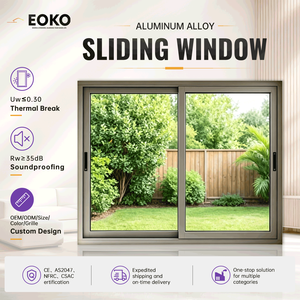
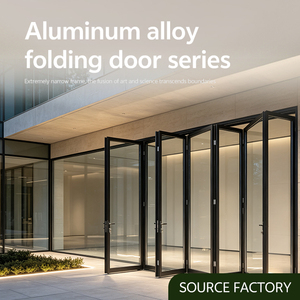
Explore our eight primary CE-marked and internationally certified systems engineered by DERCHI, spanning multi-point compression awning units, insulated thermal-break sliders, and heavy-duty pivot entries.
Solid composite hardwood core backed with heavy-duty aluminum pivot hardware, multi-point perimeter locks, and German weather seals.
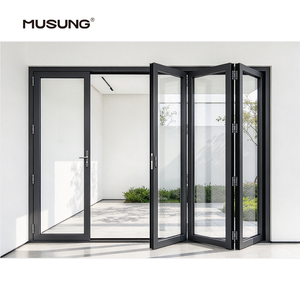
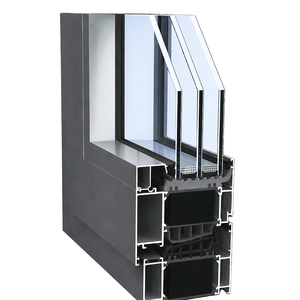
Multi-cavity PA66GF25 polyamide thermal barriers, argon filled Warm Edge spacer IGUs, achieving Uw ≤ 0.8 W/(m²·K).
Heavy-load bottom running carriage rollers, flush water-drainage sill track, and reinforced wind-load structural mullions.
Engineered with high water tightness stepped guide tracks, concealed drainage channels, and low-friction silent guide pulleys.
Honeycombed aeronautic acoustic filling, magnetic perimeter sealing dampener, delivering up to Rw 42 dB sound attenuation.
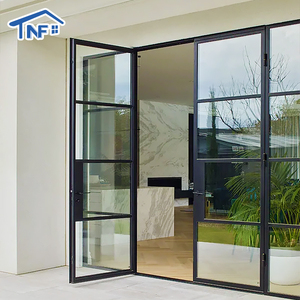
Ultra-slim architectural profile design with concealed 3D adjustable pivot hinges and high-transmittance Low-E glazing.
Heavy-gauge 2.0mm aluminum wall profiles, continuous EPDM triple gasket systems, and high water-head anti-backflow sill profiles.
German floor-spring pivot hardware, keyless digital motorized smart lock integration, and fluorocarbon anti-saline exterior finish.
In mid-to-high-rise residential architecture and commercial curtain-wall facades, awning windows provide 100% rain-screen protected ventilation. Ensuring European CE (EN 14351-1) conformity requires uncompromising engineering tolerances.
Fabricated from primary 6063-T6 or 6005-T5 architectural aluminum alloys, our awning windows feature dual-extrusion thermal breaks bridged by 24mm–34mm PA66GF25 (polyamide fiberglass reinforced) strips. This design prevents thermal bridging, eliminates condensation in tropical-subtropical indoor HVAC environments, and handles severe thermal expansion differentials without sash warping.
Top-hinged awning windows push outwards from the bottom, creating a natural rain barrier. Under high negative wind loads (suction), conventional perimeter latches often fail. DERCHI integrates 4-side multi-point locking transmission gear with auto-adjusting mushroom cams and seamless vulcanized continuous EPDM rubber seals, ensuring airtight sealing across high-altitude towers.
Structural stability hinges on high-load scissor hinge friction stays. DERCHI specifies grade SS304/SS316 austenitic stainless steel arms rated up to 180kg sash loads. Calibrated drag resistance prevents sudden wind slamming, while integrated restrictor hooks limit opening angles to 100mm–150mm for building code fall prevention without limiting natural airflow.
| Performance Criterion | European Test Standard | DERCHI Tested Metric | Commercial Advantage |
|---|---|---|---|
| Air Permeability | EN 1026 / EN 12207 | Class 4 (600 Pa ≤ 0.75 m³/(h·m)) | Prevents AC energy loss in extreme climates |
| Water Tightness | EN 1027 / EN 12208 | Class E1200 (1200 Pa sustained driving rain) | No internal water egress during typhoon rainstorms |
| Wind Load Resistance | EN 12211 / EN 12210 | Class C5 (Design P1 2000 Pa, Safety P3 3000 Pa) | Engineered for super high-rise facade installation |
| Thermal Transmittance (Uw) | EN ISO 10077-1 / 2 | Uw 1.1 – 1.4 W/(m²·K) (Triple IGU options < 0.9) | Achieves EU Energy Star and Passive House compliance |
| Acoustic Attenuation | EN ISO 717-1 | Rw (C; Ctr) = 43 (-1; -4) dB | Blocks urban traffic, airport, and highway noises |
Procurement directors, general contractors, and developers face tightening ESG mandates, embodied carbon scrutiny, and smarter building envelopes. Sourcing strategies are moving beyond unit cost to holistic lifetime lifecycle metrics.
European and North American developers increasingly mandate EPD (Environmental Product Declaration) documentation. Primary aluminum manufactured via hydro-electric or renewable smelters, combined with post-consumer recycled content (≥30%), reduces embodied carbon by up to 65% compared to coal-fired alternatives, ensuring compliance with CBAM (Carbon Border Adjustment Mechanism).
Manual awning push bars and winders are rapidly shifting toward 24V DC micro chain-drive actuators seamlessly concealed inside the aluminum head extrusion. These actuators interface directly with centralized Building Management Systems (BMS), weather stations, and CO2 monitoring arrays to automate natural night-purge cross-ventilation.
On-site installation mistakes cause over 80% of window water leakage disputes. Developers now favor prefabricated sub-frame and sub-sill extruded receptors with integrated end-dams. By transferring waterproofing responsibility from site crews to factory-assembled aluminum extrusions, projects reduce installation time by up to 35%.
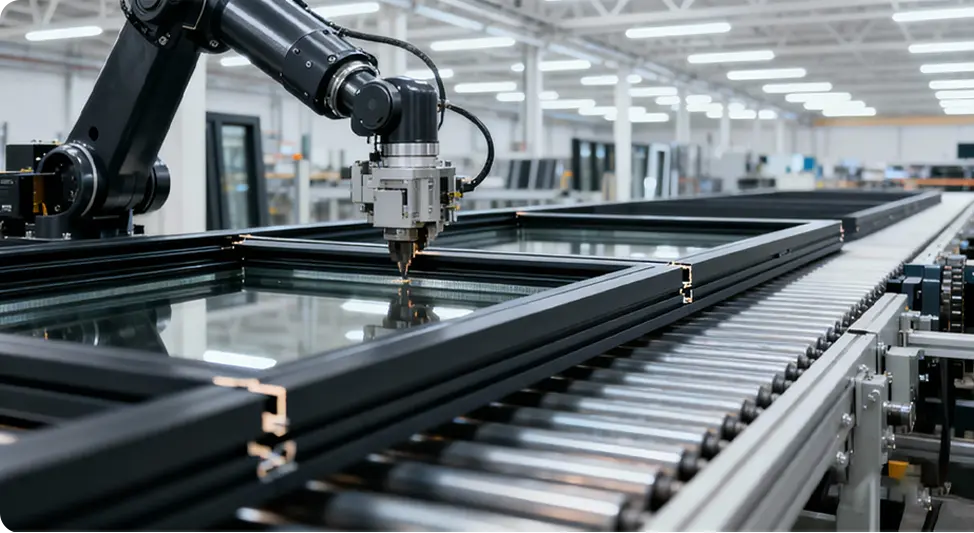
The aluminum fenestration industry is undergoing an engineering transition, replacing manual hand-assembly with automated precision machining and smart glazing robotics.
Manual angle-cutting and punching introduce angular variances of ±0.8°, creating micro-openings at frame corners. High-speed 5-axis CNC machining centers drill, rout, and mitre extrusions to ±0.1mm accuracy. Corner joints are joined with cast aluminum corner cleats, crimped hydraulically, and injected with dual-component polyoxyurethane corner adhesives.
Manual glazing bead installation can result in uneven pressure distribution across IGU edges, leading to premature argon gas leaks. Automated robotic lines apply constant pressure via robotic vacuum suckers and laser-guided two-component silicone sealants, guaranteeing consistent glass edge seals and long-term durability.
Coastal and industrial zones accelerate chalking and surface pitting. The industry is moving from standard polyester powder coating to Qualicoat Class 3 fluorocarbon (PVDF 70/30) and specialized marine-grade anodizing (25μm thickness). These treatments provide 30-year resistance to salt spray, UV degradation, and chemical etching.
Headquartered in Nanhai District, Foshan—the heart of China's aluminum extrusion manufacturing hub—DERCHI represents 25+ years of engineering innovation. With 100+ patents, including our patented Four-Side Six-Point Lock, we deliver engineered fenestration products to developers, contractors, and fabricators across Asia, Europe, Oceania, and the Americas.
Equipped with intelligent CNC lines and a dedicated workforce of 600+ specialists, ensuring dependable phased deliveries for multi-tower developments.
Fully compliant with CE (EN 14351-1), US NFRC, Australian AS2047, Canadian CSA, ISO 9001, and stringent hurricane impact standards.
Collaborating directly with structural consultants and architects on custom extrusion dies, thermal modeling, and on-site assembly guidance.
Expert answers addressing testing protocols, profile wall thicknesses, tropical moisture resilience, and international logistical coordination.
Under the European Construction Products Regulation (CPR 305/2011) and EN 14351-1, CE certification mandates accredited third-party testing for: Air Permeability (EN 12207), Water Tightness (EN 12208), Wind Load Resistance (EN 12210), Thermal Transmittance (EN ISO 10077-1/2), and Load-Bearing Capacity of Safety Devices (friction stays and limiters). DERCHI issues a full Factory Production Control (FPC) Declaration of Performance (DoP) with every export batch.
Awning windows inherently offer better water resistance than sliding windows because exterior positive wind pressure compresses the sash tighter against internal frame gaskets. For coastal typhoon zones, DERCHI equips units with 2.0mm–2.5mm heavy-gauge structural profiles, multi-point lock keepers spaced within 350mm, and tempered laminated glass (PVB or SGP interlayers) to withstand extreme wind pressures and windborne debris.
For residential villa applications, 1.4mm to 1.6mm nominal extrusion walls are common. However, for commercial facades, high-rise condominiums, and large vents, DERCHI uses 1.8mm to 2.2mm profiles conforming to GB/T 8478 and EN 12020-2 standards. This heavier gauge ensures corner-cleat stability and prevents frame deflection over long service lifespans.
In hot, humid areas like Southeast Asia, cooling loads predominate. We recommend an Insulated Glass Unit (IGU) featuring 6mm High-Performance Double-Silver Low-E + 12mm Argon Spacer + 6mm Clear Tempered Glass. This configuration achieves an SHGC (Solar Heat Gain Coefficient) ≤ 0.28, reducing solar heat gain while keeping visible light transmittance above 60%.
Yes. Our team of 30+ R&D engineers collaborates directly with client design teams. Following our structured 8-step engineering workflow—from initial drawing review, thermal and structural modeling, to custom die-casting, prototype CNC profiling, and factory water-bench testing—we deliver fully tailored fenestration systems.
Each sash and frame is covered in custom-formulated anti-scratch protective film. Corners are capped with heavy shock-absorbing corner protectors, wrapped in multi-layer foam, and crated in fumigated solid plywood crates with integrated moisture-absorbing desiccant packs to prevent transit corrosion during open-sea transit.
Planning a residential development, resort project, or commercial facade? Connect with DERCHI's fenestration engineers for shop-drawing analysis, thermal calculations, and competitive factory-direct pricing.